
Cold Email Localization: Adapting Your Message for Global Markets Beyond Translation
%201.png)
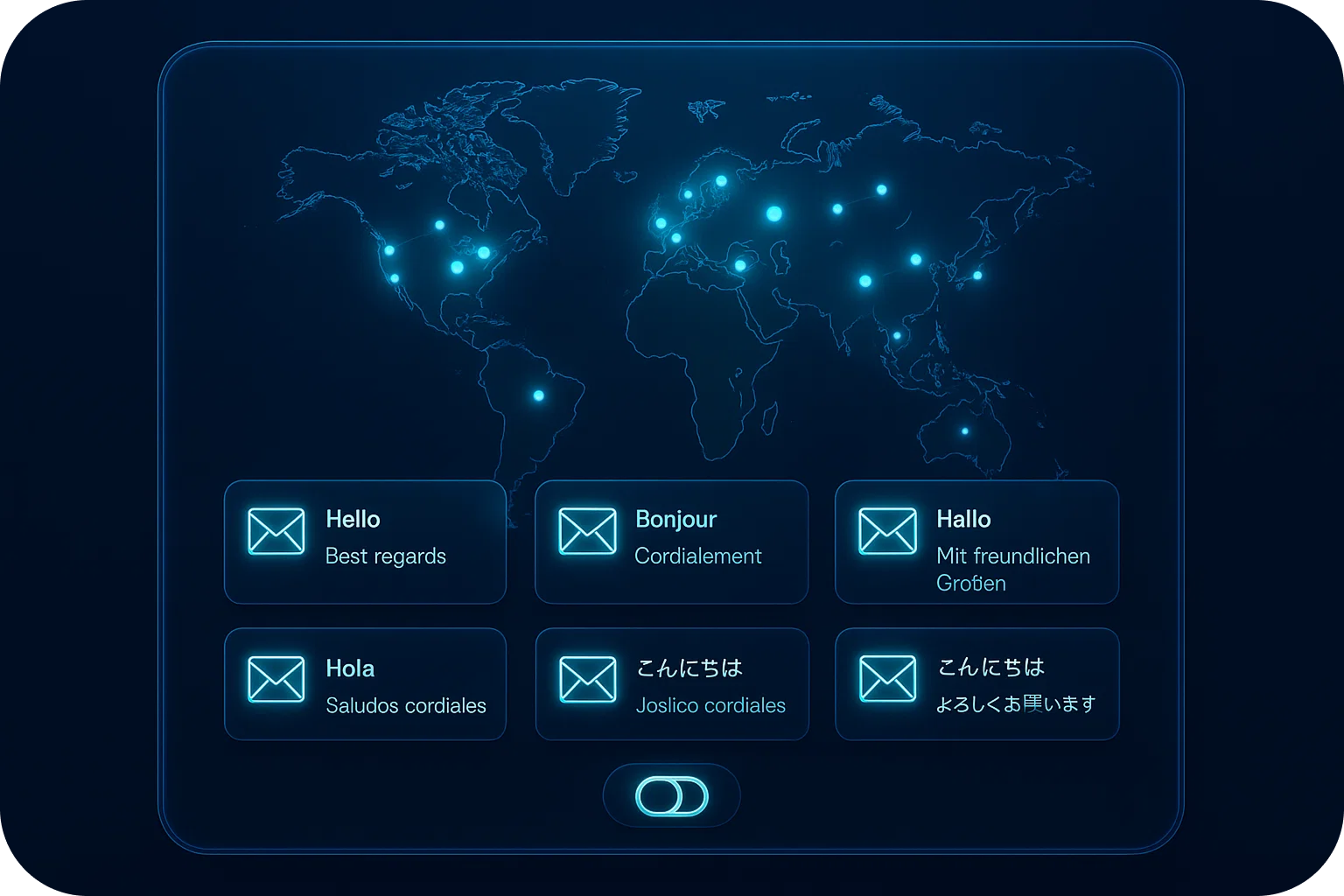
Translation alone won't win you international deals. When your cold email lands in a prospect's inbox in Berlin, Mumbai, or São Paulo, the words might be technically correct, but if the tone feels off, the timing is wrong, or your value proposition misses the mark, you've already lost.
True cold email localization goes far beyond running your copy through Google Translate. It requires understanding cultural nuances, adapting your messaging framework, and respecting regional business practices that can make or break your outreach success.
Why Translation Isn't Enough
Most companies make the mistake of treating localization as a language problem. They translate their English cold emails word-for-word and wonder why response rates plummet in international markets.
The reality? A direct translation often produces awkward phrasing that signals you're an outsider who doesn't understand the local market. Worse, it can inadvertently communicate disrespect or ignorance of cultural norms.
Consider these translation failures:
- American directness ("Let's cut to the chase") can seem aggressive in Japanese business culture
- Casual tone that works in Australia may appear unprofessional in Germany
- Humor that lands in the UK often falls flat or confuses prospects in other English-speaking markets
Effective cold email writing for global markets requires cultural adaptation, not just linguistic conversion.
Understanding Cultural Communication Styles
Different cultures have fundamentally different approaches to business communication. Your email personalization strategy must account for these variations.
High-Context vs. Low-Context Cultures
Low-context cultures (US, Germany, Scandinavia) prefer direct, explicit communication. Your cold emails should:
- Lead with the value proposition immediately
- Use clear, specific language
- Include direct calls-to-action
- Keep messages concise and structured
High-context cultures (Japan, China, the Middle East) rely on implicit communication and relationship-building. Your approach should:
- Begin with appropriate relationship establishment
- Use more formal language and honorifics
- Avoid aggressive sales language
- Allow for longer relationship development cycles
Formality Levels
The appropriate level of formality varies dramatically across markets:
Highly formal markets (Germany, Japan, France):
- Use proper titles and surnames
- Employ formal grammar structures
- Avoid casual language or slang
- Demonstrate respect through language choices
Moderately formal markets (UK, Singapore, Australia):
- Balance professionalism with approachability
- Use surnames initially, first names after rapport
- Maintain professional tone with occasional warmth
Informal markets (US, Israel, parts of Latin America):
- First names are standard from initial contact
- Conversational tone performs well
- Directness is appreciated
Adapting Your Value Proposition
Your core offering doesn't change, but how you frame its value absolutely should. Different markets prioritize different benefits based on local business challenges and cultural values.
Regional Value Proposition Frameworks
North America: Focus on ROI, efficiency gains, and competitive advantage. Quantify everything. Speed and innovation resonate strongly.
Example: "Scale your outreach 100x while maintaining 98% deliverability—all in a 10-minute setup."
Europe: Emphasize compliance, data security, and long-term partnership. GDPR compliance isn't just a feature—it's a fundamental requirement.
Example: "Enterprise-grade email infrastructure with full GDPR compliance and 99.99% uptime SLA."
Asia-Pacific: Highlight reliability, proven track record, and how established companies use your solution. Social proof carries enormous weight.
Example: "Trusted by over 2,000 companies worldwide, including leading tech firms across India, Singapore, and Australia."
Latin America: Stress relationship-building, local support, and adaptability to regional needs. Personal connection matters.
Example: "Join growing companies across Latin America who've transformed their outreach with dedicated support in your timezone."
Timing and Sending Strategy
When you send matters as much as what you send. Global cold email campaigns require strategic timing based on local business hours, cultural calendars, and regional email behavior patterns.
Optimal Send Times by Region
Europe: Tuesday-Thursday, 8-10 AM local time. Avoid August (vacation month) and December holidays.
United States: Tuesday-Thursday, 9-11 AM EST/PST. Avoid major holidays and summer Fridays.
Asia-Pacific: Wednesday-Thursday, 9-11 AM local time. Be mindful of Lunar New Year, Diwali, and regional holidays.
Middle East: Sunday-Wednesday (different work week). Avoid Ramadan for aggressive outreach.
With infrastructure supporting unlimited domains and email accounts across multiple providers, you can segment your outreach by timezone and market, ensuring every message arrives at the optimal moment.
Cultural References and Social Proof
The examples, case studies, and references you include should resonate with your target market's context.
Localizing Social Proof
Generic approach: "We work with leading companies worldwide."
Localized approach:
- Germany: "Trusted by German mittelstand companies and enterprise organizations"
- India: "Supporting Bangalore's fastest-growing tech startups and established IT services firms"
- US: "Powering outreach for Y-Combinator companies and Fortune 500 sales teams"
Avoiding Cultural Missteps
- Sports metaphors: Baseball references mean nothing outside North America
- Idioms: "Think outside the box" doesn't translate conceptually
- Holidays: "New Year's resolution" timing varies globally
- Humor: Rarely translates well; when in doubt, stay professional
Email Personalization Across Cultures
Personalization remains critical, but what counts as "personalized" varies by market.
Western markets: Company research, recent news mentions, mutual connections, specific pain points.
Eastern markets: Proper titles, company hierarchy acknowledgment, industry-specific challenges, regional market conditions.
Universal personalization elements:
- Correct name spelling and pronunciation
- Accurate company information
- Relevant industry insights
- Appropriate formality level
- Local timezone consideration
Technical Considerations for Global Outreach
Localization isn't just about copywriting; it's about infrastructure that supports international delivery.
Provider Selection by Region
Different email providers have varying deliverability rates across regions:
- Google Workspace: Strong global deliverability, especially in Asia-Pacific and Europe
- Microsoft 365 Outlook: Excellent for European enterprise and North American corporate
- Shared IP options: Cost-effective for testing new markets before scaling
Domain Strategy for International Markets
Consider using country-specific domains (.de, .co.uk, .in) for major markets. This signals local presence and can improve deliverability and trust.
Best practices:
- Maintain 3-5 inboxes per domain maximum
- Warm up new domains for 3-4 weeks before full-scale sending
- Keep sending volume at 20 emails per inbox per day for optimal deliverability
- Use dedicated IPs for high-volume enterprise campaigns in specific regions
Building Your Global Localization Framework
Step 1: Market Research Understand your target market's communication preferences, business culture, and pain points before writing a single email.
Step 2: Native Speaker Review Always have native speakers review your localized copy—not just for language accuracy, but for cultural appropriateness.
Step 3: A/B Testing by Market What works in one market may fail in another. Test subject lines, email length, formality levels, and CTAs separately for each region.
Step 4: Infrastructure Scaling Ensure your email infrastructure can support multiple domains, providers, and sending patterns across timezones without compromising deliverability.
Step 5: Continuous Optimization Monitor inbox placement rates, response rates, and engagement metrics by market. Adjust your approach based on data, not assumptions.
Measuring Localization Success
Track these metrics separately for each market:
- Inbox placement rate: Should maintain 96-98% regardless of market
- Open rates: Vary by culture; compare against regional benchmarks
- Response rates: Quality matters more than quantity
- Meeting conversion: The ultimate measure of localization effectiveness
- Unsubscribe/spam rates: High rates signal cultural misalignment
Scaling Global Outreach Without Sacrificing Quality
The challenge of international cold email isn't just localization, it's maintaining high deliverability and personalization at scale across multiple markets simultaneously.
This requires infrastructure that supports:
- Multiple email providers for regional optimization
- Unlimited domains for market-specific campaigns
- Automated deliverability management across all accounts
- Quick implementation that doesn't slow down global expansion
When you can spin up localized email infrastructure in 10 minutes and maintain 98% deliverability across all markets, you remove the technical barriers that prevent most companies from effectively scaling internationally.
Conclusion
Cold email localization is your competitive advantage in global markets. While your competitors send translated templates that feel foreign and impersonal, you can craft culturally adapted messages that resonate with prospects on their terms.
The companies winning international deals aren't just translating; they're adapting tone, timing, value propositions, and technical infrastructure to meet each market where it is.
Start with one international market. Research deeply, adapt thoughtfully, test rigorously, and scale confidently. With the right approach to copywriting and the infrastructure to support global deliverability, your cold email outreach can succeed anywhere in the world.
Ready to scale your cold email outreach globally? Build the infrastructure that supports localized campaigns across unlimited domains and email accounts, with enterprise-grade deliverability in every market.
More articles



Get started now


